Learn more
Advanced Manufacturing Myths Debunked: Why U.S. SMBs Are Falling Behind (and How to Compete)
Resources

Advanced Manufacturing Myths Debunked: Why U.S. SMBs Are Falling Behind (and How to Compete)

For the American SMB, maintaining the status quo is no longer a viable business strategy. To bridge the automation adoption gap, U.S. business owners and operations leaders must systematically address three legacy myths that continue to stifle domestic progress.

May 20, 2026

The modern global manufacturing landscape is characterized by a stark divergence in automation maturity. In the race for industrial modernization, "robot density", or the number of operational industrial robots per 10,000 employees, has emerged as a leading indicator of a nation’s long-term economic competitiveness. While the average global robot density has doubled over the past decade, the distribution of these advanced assets is highly asymmetrical.

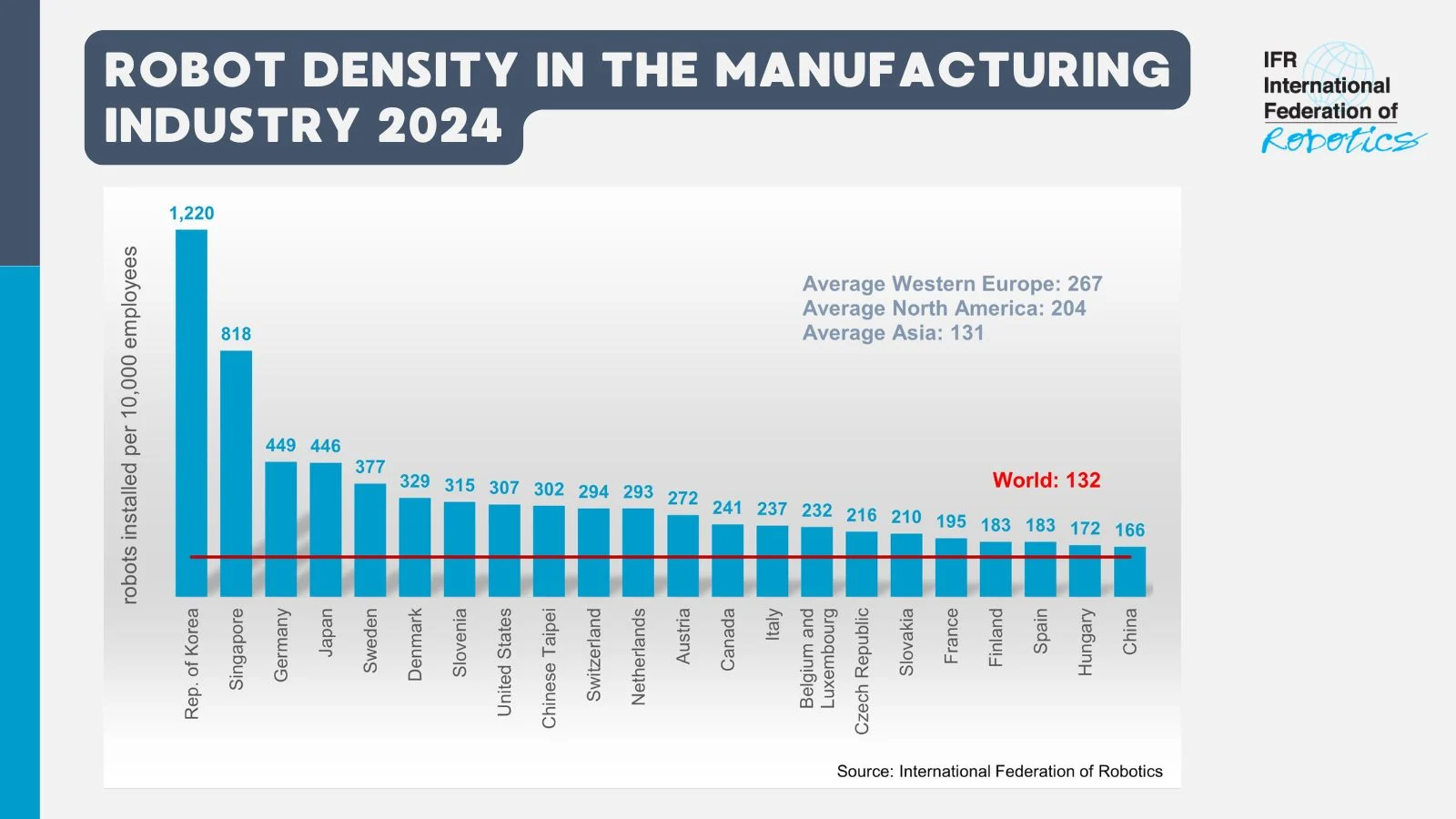
Looking at most recent data from 2024, Western European countries maintain a record intensity of 267 robots per 10,000 manufacturing employees, driven by consistent annual growth in industrial powerhouses like Germany. Asia follows closely in volume, anchoring its growth in high-velocity markets like China—which now holds over 2 million operational units, representing roughly 43% of the global stock—and hyper-automated hubs like Singapore (818 units) and Japan (446 units).

The United States currently ranks 8th worldwide with 307 units per 10,000 employees. On paper, this position appears respectable. In operational reality, however, this number is heavily skewed. The vast majority of robotic installations in North America are concentrated within the high-volume automotive and electronics sectors. In the broader "general industry" category—which encompasses thousands of small and medium-sized businesses (SMBs) that make up 75% of all global manufacturing firms—the adoption rate drops precipitously. Currently, only 12% of small-to-mid-sized manufacturers globally have adopted robotics in any form.

This massive adoption chasm is not a product of financial insolvency or a lack of interest. According to recent market data, an overwhelming 92% of manufacturing executives agree that automation is essential for long-term competitiveness, yet only 37% report having significant or full automation in place on their shop floors. To bridge this critical execution gap, U.S. small business owners and operations leaders must systematically address three legacy myths that continue to stifle domestic progress.

Visualizing the Global Automation Chasm

To understand the scale of the competitive challenge facing domestic operations, consider the stark contrast in robot densities across leading economies:

Source: International Federation of Robotics, 2024 Dataset

This disparity highlights a clear bottleneck. While American enterprise-level facilities compete on a global scale, the typical U.S. high-mix factory and job shop remains a manual island in an increasingly automated global supply chain. This friction is driven by three main operational misconceptions:

Myth 1: "Our Volume is Too Low / High-Mix is Too Complex"

For decades, the standard playbook dictated that industrial robotics belonged exclusively to mass production lines. Traditional robotic systems are rigid, relying on fixed, precision setups, highly predictable environments, and uniform inputs to justify their massive integration timelines. If a factory floor did not run the exact same metal stamping or plastic mold a million times over, the cost of programming a robot made the investment mathematically non-viable.

In recent years, this dynamic has been fundamentally disrupted. While legacy "fixed" automation still commands a large share of high-volume goods, flexible and modular automation is advancing rapidly at a 13.7% CAGR. High-mix, low-volume factories and job shops are no longer locked out of the automation world.

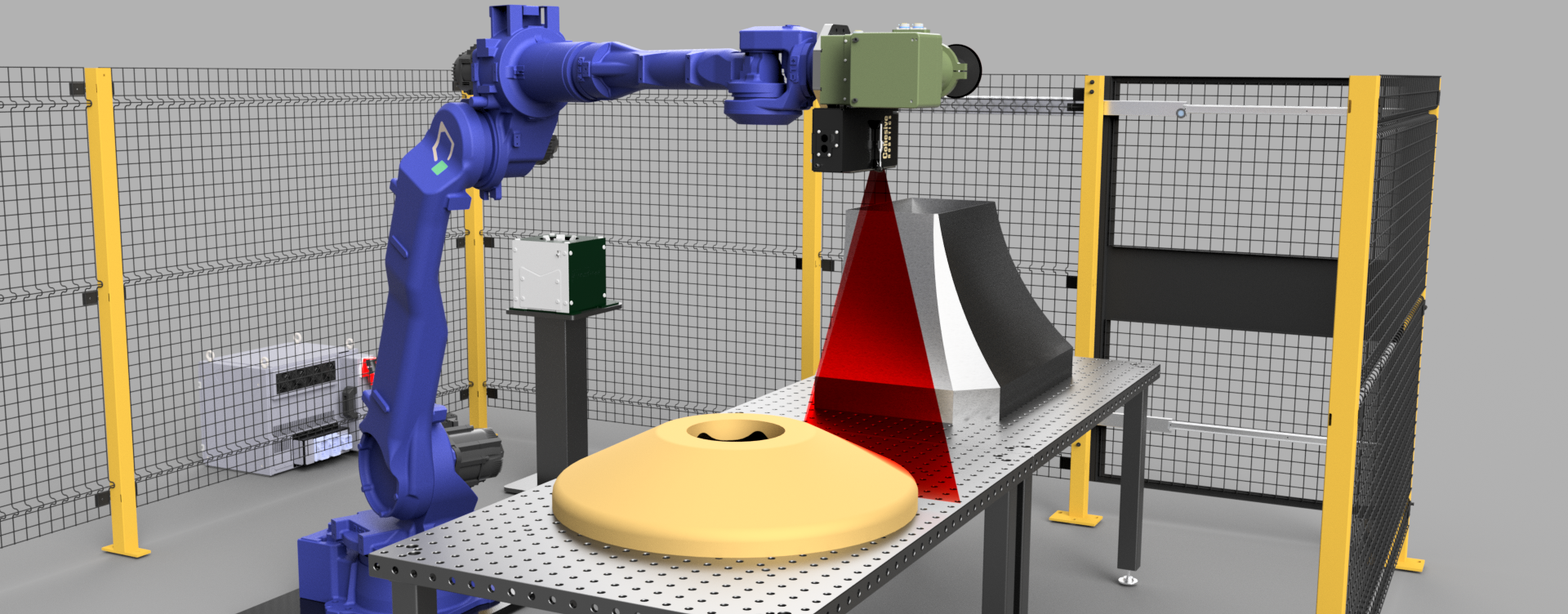
One of the key breakthroughs lies in the abstraction of the software layer. Modern, AI-powered operating systems, have shifted intelligence from rigid, hard-coded programming to adaptive solutions. Utilizing integrated 3D vision systems, these platforms perform "Live Scans" of incoming parts, automatically generating precise robotic toolpaths on the fly without requiring CAD files, pre-taught paths, or manual programming. This allows high-mix operations to run highly varied batches with zero changeover downtime, immediately democratizing precision finishing, welding, and sanding for smaller facilities.

Myth 2: "We Lack the Technical Expertise to Manage Robots"

The second major barrier to adoption is technical intimidation. According to the State of the Market report, 39% of manufacturers cite a lack of internal expertise as a primary reason for stalling automation projects, and 50% struggle to identify the correct technologies to deploy. Historically, integrating a single robot required hiring specialized integration firms, often inflating the final bill past $500,000 per workcell and creating long-term dependence on expensive technicians for programming and maintenance.

Modern automation platforms address this complexity by eliminating or dramatically simplifying the programming requirement. Rather than writing lines of complex robot code, operators interface with user-friendly Human-Machine Interfaces (HMIs). Turnkey, pre-engineered workcells can be unboxed, calibrated, and running initial production runs in hours, utilizing simple graphical interfaces or intuitive hand-guided teaching.

By shifting the engineering burden onto intelligent local software, factories with fewer than 30 employees can confidently deploy, reconfigure, and scale automated welding, sanding, or deburring cells without hiring a single specialized technician.

Myth 3: "Automation Will Decimate Our Workforce and Ruin Shop Culture"

The fear of job displacement remains a significant source of organizational friction, stalling approvals and retraining programs across domestic facilities. However, the macroeconomic reality of 2026 paints a completely different picture. In early 2025, nearly 500,000 manufacturing roles went unfilled across the United States and Canada, driven by a persistent skilled-labor shortage and an aging demographic. Robots are not stealing jobs; they are filling a dangerous structural vacancy.

Furthermore, integrating automation acts as a powerful tool for workforce retention. By delegating the "3Ds" (tasks that are Dirty, Dull, and Dangerous) to robotic workcells, manufacturers protect their human operators from hazardous conditions, heavy lifting, toxic fumes, and highly repetitive, unergonomic routines. This also helps prolong careers and retain institutional knowledge within an organization.

Data from the Warehouse Workers Sentiment Report validates this positive cultural impact:

  • Job Satisfaction: 63% of workers report significantly higher job satisfaction when working alongside automated systems compared to purely manual operations.
  • Physical Strain: 59% of operators report a dramatic decrease in physical strain on their bodies.
  • Safety & Retention: 60% of automated facilities report fewer workplace injuries, and workers partnering with automation are more than three times as likely to stay at their jobs longer.

Moreover, a comprehensive European study tracking robot adoption revealed a 4.3% reduction in workplace fatality rates and a 3.2% reduction in injury rates. When robots assume the physical burden of tasks like high-vibration sanding or grinding, human workers are freed to upskill into higher-value, intellectually stimulating roles—such as quality control, process optimization, and strategic programming—boosting both operational margins and employee morale.

Conclusion: The Cost of Inaction

For the American SMB, maintaining the status quo is no longer a viable business strategy. As reshoring pressures compound and global competitors leverage smart-factory metrics to drive down unit costs, the "innovation paralysis" of relying on manual labor represents an existential risk.

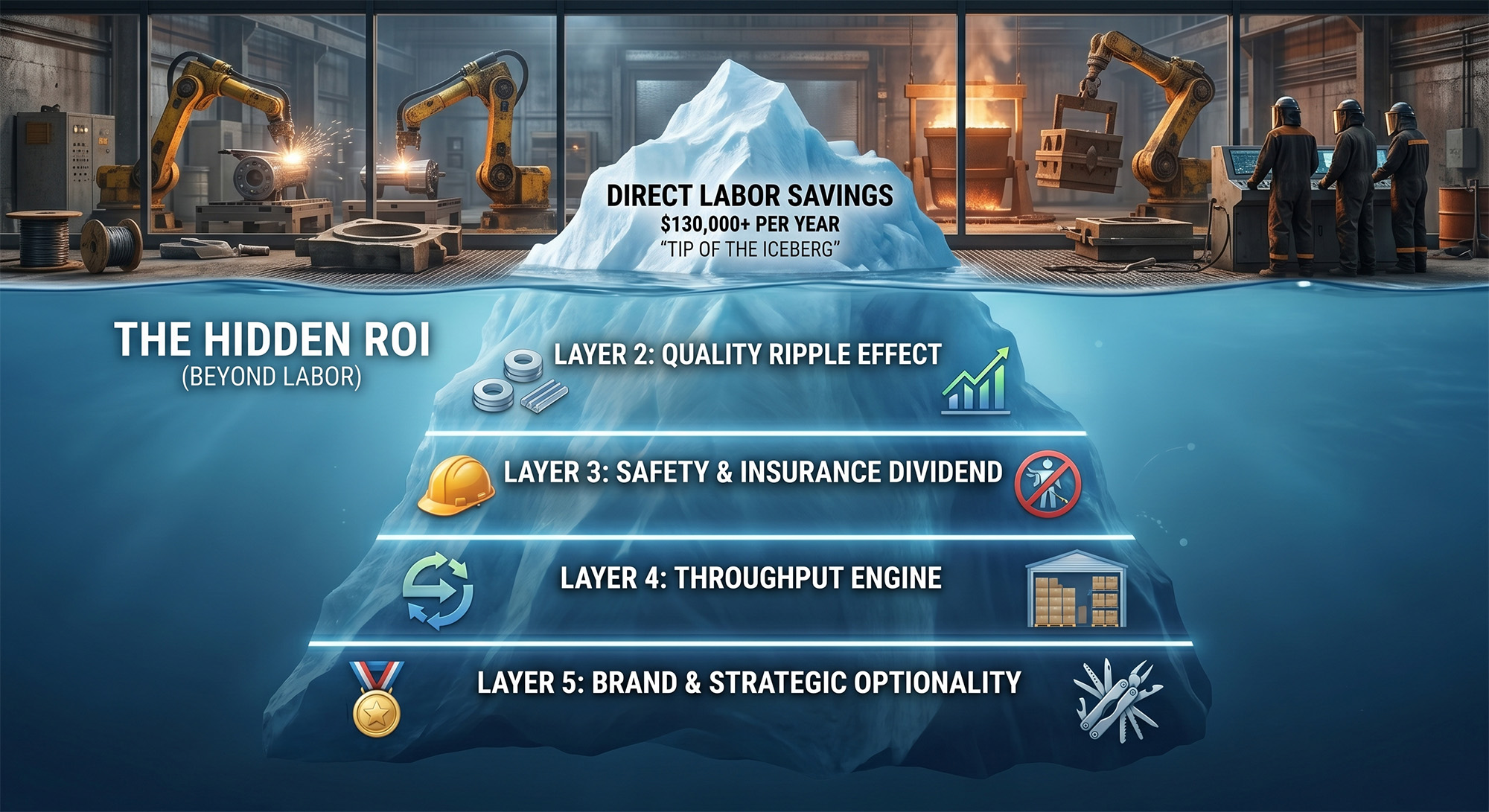
Turnkey smart robotic workcells are now available at $100,000, or less with varying feature sets. With average domestic labor savings exceeding $130,000 annually per workcell, paired with a 60% average reduction in rework and scrap, these systems routinely deliver a full return on investment in under two years. The technology has matured, the software has simplified, and the economic mandate is clear. To survive the next decade of industrial competition, U.S. manufacturers must continue to accelerate automation adoption.

ABOUT THE AUTHOR

Enjoyed this read?

Stay up to date with the latest Cohesive Robotics news, automation strategies, and insights sent straight to your inbox!

Almost done! Check your email to verify signup.
Oops! Something went wrong. Please try again.